
A decade ago, tracking down a missing person, verifying an identity, or sifting through hours of surveillance footage meant weeks of legwork. Today, a private investigator AI can compress that work into minutes — running a face through billions of public images, transcribing a recorded interview in 49 languages, or mapping a suspect's entire digital footprint from a single photo. This guide explains what an AI private investigator actually is, what these tools can and cannot do, the real risks involved, and the five leading platforms — with features, pricing, strengths, shortcomings, and user reviews. It also tackles a question regulators are racing to answer: who investigates AI itself?

- A private investigator AI is software that automates investigative tasks — facial recognition, OSINT people-search, evidence transcription, and data analysis — that once took investigators days of manual work.
- AI is a force multiplier, not a replacement. It surfaces leads fast, but a human PI still verifies findings, applies legal judgment, and stands behind the evidence in court.
- The biggest risks are accuracy bias and privacy law. NIST found some algorithms misidentify people of color 10–100x more often than white men — which is why oversight of "who investigates AI" matters as much as the tools themselves.
What Is a Private Investigator AI?
A private investigator AI is any artificial-intelligence tool that automates or accelerates the core tasks of an investigation: finding people, verifying identities, processing evidence, and connecting scattered data points into a coherent picture. Rather than replacing the investigator, it acts as a tireless digital assistant that handles the slow, repetitive, large-volume work — leaving the human to do the reasoning, the fieldwork, and the judgment calls.
Modern investigations generate overwhelming amounts of audio, video, and digital evidence. Legal professionals and investigators face mounting pressure to analyze it all quickly while maintaining court-grade accuracy. The right AI private investigator toolkit turns hours of manual review into minutes of automated analysis — and that shift is why AI has moved from novelty to necessity in the field.
What Can an AI Private Investigator Do?
The capabilities of private investigator AI fall into a few clear categories. Most professional investigators combine several tools rather than relying on one.
| Capability | What it does for investigators |
|---|---|
| Facial recognition & reverse image search | Matches a single photo to public web appearances, even across aging, lighting, angle, or disguise changes — connecting one image to a wide digital footprint. |
| OSINT people-search | Aggregates public records, social profiles, phone numbers, and addresses into a single background report in seconds. |
| Evidence transcription & translation | Converts interviews, depositions, and surveillance audio into searchable, timestamped text — often in dozens of languages — cutting processing time by up to 90%. |
| Document & eDiscovery analysis | Reviews huge volumes of documents and communications, flagging relevant evidence and patterns far faster than manual review. |
| Link analysis & geolocation | Maps relationships between people, accounts, and events; some tools infer location from visual cues in a photo without metadata. |
| Legal intelligence | Scans court filings, regulations, and legal databases to surface emerging risks, patterns, or case opportunities. |
5 Leading Private Investigator AI Tools
Here are five of the most widely used AI private investigator platforms in 2026, spanning facial recognition, OSINT, and evidence processing. Each solves a different part of the investigative puzzle.
1. PimEyes — Facial Recognition
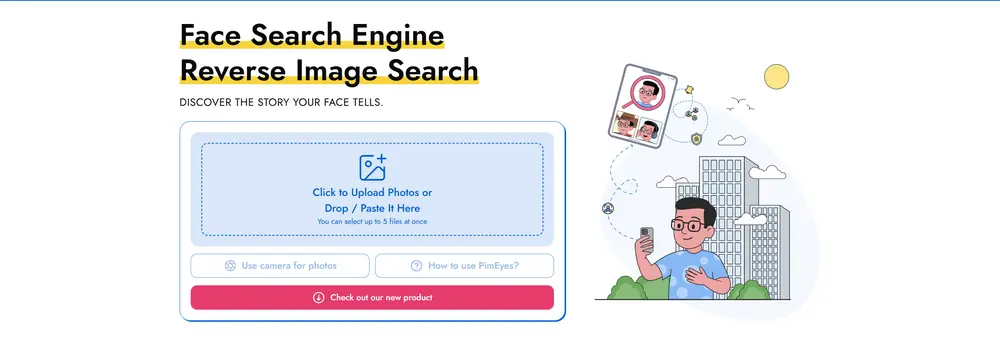
PimEyes is widely regarded as the gold standard for face search. It uses biometric algorithms to map facial structure — distances between the eyes, jawline, nose contour — so it can find matches even when a subject has aged, changed hairstyle, or is wearing glasses. A dedicated OSINT portal serves professional investigators with deeper, verified searches.
- Features: open-web facial search, source links and context, persistent alerts for new appearances, a PROtect plan for removal requests.
- Price: consumer plans roughly $30–$300/month depending on search volume and alerts; OSINT/enterprise tier priced separately.
- Strengths: massive index, high accuracy on public images, strong for person-of-interest research.
- Shortcomings: accuracy varies with image quality; raises significant privacy concerns and is restricted in some jurisdictions.
- User review (paraphrased): investigators call it indispensable for connecting a face to a digital footprint, while noting results should always be corroborated.
2. Lenso.ai — Reverse Face & Image Search
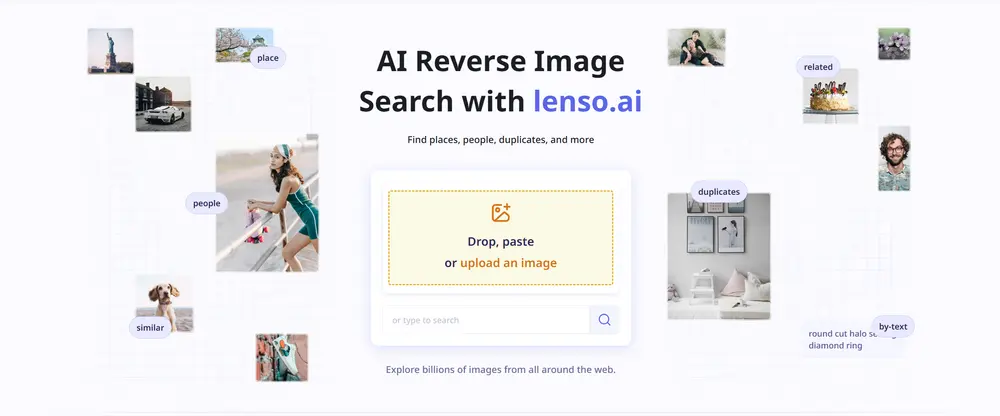
Lenso.ai focuses purely on facial and image recognition, returning matches from just one photo even when the image is altered, the person has aged, or the shot was taken from a different angle. Beyond faces, it finds exact duplicates, places shown in a photo, and related images.
- Features: face search, place and duplicate search, a "Research Mode" that surfaces up to 10,000 results, plus an API for workflow integration.
- Price: free tier with limited searches; paid plans typically start around $30/month.
- Strengths: precise recognition across lighting and angle variation; easy API integration; diverse result sets.
- Shortcomings: narrower than full OSINT suites; still maturing versus PimEyes' index size.
- User review (paraphrased): praised as one of the most effective ways to learn about a person when all you have is an image.
3. Pixalytica — AI-Powered OSINT Reports
Pixalytica combines a facial-recognition engine with AI that compiles a full person dossier. Upload an image and, in under 20 seconds, it returns a report covering background summary, risk factors, possible criminal history, and suspicious correlations.
- Features: face-match aggregation, automated background reports, risk-factor flagging, fast identity-check workflow.
- Price: subscription/credit-based; quote varies by report volume (check current pricing).
- Strengths: speed and breadth — combines face search with wider data in one report.
- Shortcomings: automated "risk" and "criminal history" outputs demand careful human verification to avoid false conclusions.
- User review (paraphrased): reviewers highlight the all-in-one report and sub-20-second turnaround as standout features for fast identity checks.

4. Maltego / Social Links — Link Analysis & OSINT Mapping
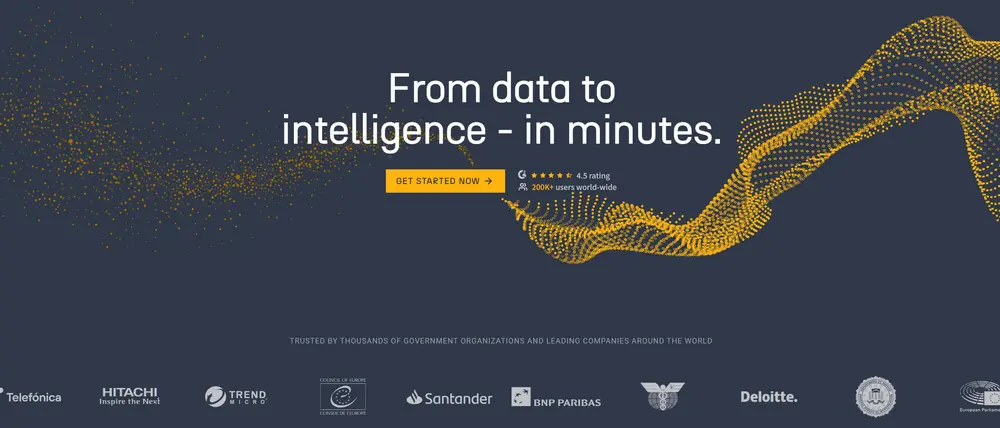
Maltego (often paired with Social Links data) is the go-to for visual link analysis. It connects people, accounts, domains, and events into interactive graphs, making it invaluable for social-media investigations, fraud, and mapping networks of relationships.
- Features: entity link-graphs, social-media and dark-web data transforms, batch processing, real-time monitoring alerts.
- Price: a free community edition exists; professional and enterprise licenses run into the thousands per year.
- Strengths: unmatched for visualizing complex relationships and large-scale OSINT.
- Shortcomings: steep learning curve; full data access requires paid transforms.
- User review (paraphrased): analysts rate it the standard for social-media and network investigations, though they note it rewards training.
5. Sonix — Evidence Transcription & Translation
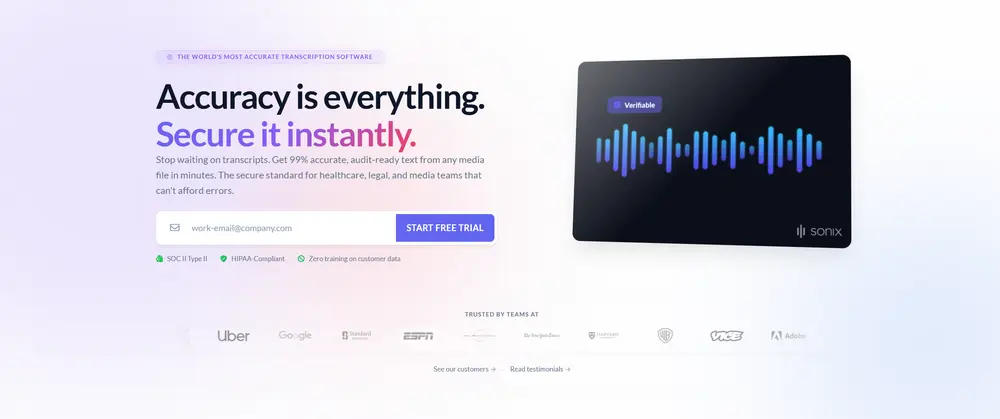
Sonix is a leading AI transcription platform built for legal-grade evidence processing. It turns surveillance audio, witness interviews, and depositions into accurate, timestamped, searchable transcripts across 49 languages — addressing the everyday bottleneck of processing recorded evidence.
- Features: speaker identification, automated translation and subtitles, keyword search across hours of audio, SOC 2 Type II security, workflow integrations.
- Price: pay-as-you-go around $10/hour; subscription tiers for teams; 30 free minutes, no card required.
- Strengths: industry-leading accuracy, multilingual support, court-ready timestamps and confidence scoring.
- Shortcomings: focused on audio/video — not a people-search or document-discovery tool; best paired with others.
- User review (paraphrased): rated 4.8/5 across 1,000+ teams; users value the speed and the time saved versus manual transcription.
💡 Pro tip: Experienced investigators use a "multi-tool" approach — a face-search engine (PimEyes or Lenso.ai) to find a lead, an OSINT suite (Pixalytica or Maltego) to expand it, and a transcription tool (Sonix) to process the evidence. No single platform does everything, and over-reliance on one tool is itself a risk.
Strengths and Risks of Private Investigator AI
AI brings undeniable advantages to investigations — but also serious risks that every responsible investigator must understand. Here is the honest balance.
Strengths
- Processes evidence up to 90% faster than manual methods
- Surfaces leads from a single photo or data point
- Handles multilingual and large-volume evidence
- Consistent, searchable, timestamped output
- Frees investigators to focus on judgment and fieldwork
Risks
- Demographic bias: higher misidentification of people of color and women
- False positives can trigger "tunnel vision" on the wrong person
- Privacy law violations (GDPR, BIPA, state laws)
- "Hallucinated" or unverified automated conclusions
- Chain-of-custody and admissibility challenges in court
The accuracy concern is not hypothetical. A landmark NIST evaluation of 189 facial-recognition algorithms found false-positive rates for Asian and African American faces were 10 to 100 times higher than for white men in many systems. The Innocence Project has documented wrongful arrests stemming from face-match errors, and the Brookings Institution warns that these inaccuracies are systemic, not one-offs. The practical lesson: an AI match is a lead, never proof.
Who Investigates AI? The Oversight Question
If AI is now investigating us, a fair question follows: who investigates AI? As facial recognition and OSINT tools spread, oversight is catching up on several fronts.
- Standards bodies: the U.S. National Institute of Standards and Technology (NIST) independently tests algorithm accuracy and demographic bias, and maintains the AI Risk Management Framework that organizations use to identify and mitigate AI risks.
- Regulators & lawmakers: the EU AI Act classifies remote biometric identification as high-risk; in the U.S., state laws like Illinois' BIPA and various municipal bans restrict facial-recognition use. The National Academies has urged federal action, noting technology has outpaced the law.
- Civil-society watchdogs: groups like the ACLU and academic researchers audit systems, publish bias findings, and push for transparency and accountability.
- The investigators themselves: ethical professionals maintain clear boundaries between public information and private communications — "just because you can access data doesn't mean you should."
For investigators, the takeaway is to treat compliance as a core skill: know your local privacy laws, document your methods, and never let an automated output substitute for human verification.
How to Choose the Right AI Private Investigator Tool
Picking the right private investigator AI depends on your work. A few guiding questions:
- Evidence type: face/image leads point to PimEyes or Lenso.ai; recorded audio/video points to Sonix; relationship mapping points to Maltego.
- Accuracy needs: for anything heading to court, prioritize tools with confidence scoring, audit trails, and a human-review step.
- Language & reach: international cases need strong multilingual support.
- Security & compliance: look for SOC 2 Type II, encryption, access controls, and data-residency options.
- Integration: the tool should fit your existing case-management workflow.
Conclusion
A private investigator AI is one of the most powerful additions to the modern investigator's toolkit — capable of compressing days of work into minutes across facial recognition, OSINT, and evidence processing. Tools like PimEyes, Lenso.ai, Pixalytica, Maltego, and Sonix each excel at a different stage of the workflow, and the best results come from combining them. But the same power that finds a suspect in seconds can also misidentify an innocent person, so accuracy bias, privacy law, and the question of who investigates AI are not afterthoughts — they are central to using an AI private investigator responsibly. Use AI to find the lead; rely on human judgment to prove the case.

FAQs
What is a private investigator AI?
It's software that automates investigative tasks — facial recognition, OSINT people-search, evidence transcription, document analysis, and link mapping. It accelerates the slow, large-volume work so a human investigator can focus on judgment, fieldwork, and verification.
Can an AI private investigator replace a human PI?
No. AI is a force multiplier that finds leads fast, but it can't apply legal judgment, conduct interviews, testify, or be held accountable for an investigation. Human investigators verify AI findings and stand behind the evidence.
Are private investigator AI tools accurate?
Accuracy varies and bias is a real concern. NIST found some facial-recognition algorithms misidentify people of color 10–100x more often than white men. An AI match should always be treated as a lead to verify, never as proof.
Is it legal to use facial recognition for investigations?
It depends on your jurisdiction. The EU AI Act treats biometric identification as high-risk, and U.S. laws like Illinois' BIPA and various city bans restrict use. Investigators must know local privacy law and document their methods.
Who investigates AI itself?
Oversight comes from standards bodies (NIST), regulators and lawmakers (EU AI Act, state privacy laws), civil-society watchdogs (ACLU, academic researchers), and ethical investigators who set their own boundaries between public and private data.