
If you have ever ranked #1 on Google and still watched an AI assistant recommend a competitor, you have already met the problem Ziptie AI search analytics was built to solve. As buyers shift from ten blue links to a single AI-generated answer, the old question — "where do I rank?" — is being replaced by a new one: "when an AI talks about my category, does it mention me or my rival?" This guide answers what is Ziptie AI search analytics, what the Ziptie AI search performance tool can actually do,what it costs, its real strengths and shortcomings, and how it compares with ChatGPT and Gemini — plus five strong alternatives worth knowing.
Why AI Search Analytics Suddenly Matters
For two decades, SEO meant climbing the blue-link rankings. That formula is breaking. According to Conductor's analysis of 21.9 million queries, AI Overviews now appear in roughly 25% of all Google searches, up from about 13% in March 2025, and BrightEdge's commercial-vertical tracker puts the figure as high as 48%. Gartner projects that traditional search volume will fall 25% by 2026 as users lean on AI assistants. Most sobering for SEO teams: being ranked #1 in organic results only earns an AI citation a fraction of the time — the overlap between Google's top-10 and AI citations has fallen from around 75% in mid-2025 to roughly 17–38% in early 2026.
The takeaway is blunt. You can win traditional SEO and still be invisible inside AI answers — and you would never see it in Google Search Console or Google Analytics. That blind spot is exactly what ziptie + SEO workflows are designed to expose.
What Is Ziptie AI Search Analytics?
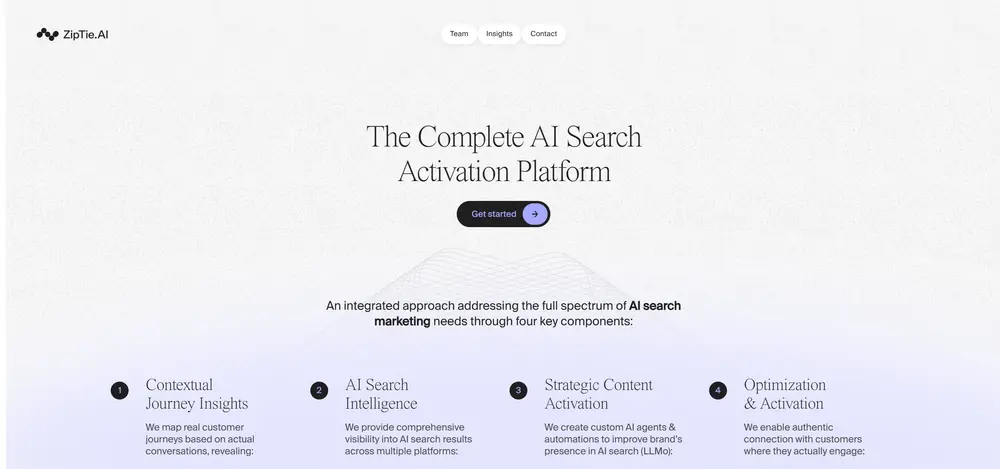
Ziptie (ziptie.dev) is a cloud-based AI search monitoring and optimization platform that tracks, measures, and helps improve how your brand appears inside AI-generated search results. Rather than measuring keyword rankings and backlinks, it focuses on a different layer of visibility entirely: how AI search engines perceive, mention, cite, and recommend your brand.
It was built by Tomasz Rudzki, Bartosz Góralewicz, and Sebastian Skowron — the team behind Onely, are spected technical-SEO agency — which is a big part of why the tool carries credibility with practitioners who value accuracy over marketing gloss. SEO authorities including Lily Ray and AleydaSolís have publicly recommended Ziptie, particularly for its competitive intelligence and the accuracy of its detection method.
Specifically, Ziptie monitors your brand across three major AI surfaces:
- Google AI Overviews — the AI-generated answer blocks at the top of Google results
- ChatGPT — including its Browse and Search capabilities
- Perplexity — the AI-native search engine growing fast among professional users
One detail sets it apart from many rivals: Ziptie uses real browser-level technology (and real Google accounts) instead of API approximations, capturing exactly what users see — full answer text plus downloadable screenshots. In head-to-head benchmarks, this approach detected AI Overviews on 28% of tracked keywords where some API-based tools caught as little as 1.6% of the same set.
What the Ziptie AI Search Performance Tool Can Do
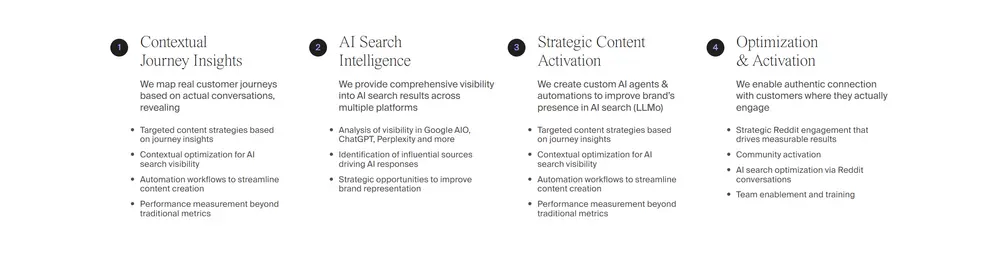
So, what is the Ziptie AI search performance tool in practice? It runs a closed feedback loop: discover the prompts that matter, measure how you appear, score the gaps, tell you what to fix, then confirm whether the fix worked. Here are its core features.
| Feature | What it does |
|---|---|
| AI Search Monitoring | Captures live results from Google AI Overviews, ChatGPT, and Perplexity, including exact answer text and downloadable screenshots — an audit of what users actually see, not a simulation. |
| AI Success Score | The flagship metric. Blends mention frequency, citation presence, answer placement, and sentiment into one prioritized score per query, weightable by engine and region. |
| Citation Share Tracking | The percentage of relevant AI answers that cite your domain. Above 35% in a niche is considered dominant; below 15% signals high displacement risk. |
| Brand Mention & Sentiment | Tracks when AI names your brand without linking, and whether the framing is positive, neutral, or negative. |
| Competitive Benchmarking | Shows which competitors AI prefers for your queries, how their score compares, and which of their pages get cited. |
| Content Optimization | Analyzes winning pages vs. yours, flags missing entities, thin explanations, and weak evidence, then hands writers a page-specific brief. |
| Query Discovery Assistant | Automated query generation: expands seed keywords into dozens of conversational, long-tail prompts real users actually ask AI tools. |
| Indexing Health Monitor | Alerts you to crawl errors, sitemap issues, and deindexed pages that suppress both traditional and AI visibility. |
| GSC Integration | Imports Google Search Console data for faster setup; exports to Google Analytics or Tableau for deeper reporting. |
💡 Key definition: "Generative Engine Optimization" (GEO) is the practice of structuring content so AI engines cite it as a source. A Princeton, Georgia Tech, Allen Institute, and IIT Delhi study (Aggarwal et al., KDD '24) found GEO methods — especially adding statistics, citing sources, and adding quotations — can lift visibility in AI answers by up to 40%. Ziptie is a tool for measuring and acting on that visibility.
Why Choose Ziptie AI Search Analytics? (Pros and Cons)
The honest answer to why choose Ziptie AI search analytics is that it does one job — accurate, actionable AI-Overview-era visibility — better than most generalist tools. But it is not without gaps. Here is the balanced view of the pros and cons of using Ziptie.ai for SEO.
Strengths
- Browser-level accuracy: real sessions catch AI Overviews that API tools miss entirely
- Action, not just monitoring: page- and section-specific optimization briefs, not generic checklists
- AI Success Score turns hundreds of prompts into a clear weekly priority queue
- Credible pedigree: built by the Onely team; endorsed by Lily Ray and Aleyda Solís
- Accessible entry price and a 14-day free trial to test before buying
Shortcomings
- Only three engines: no Claude, Gemini, Google AI Mode, Copilot, Grok, or DeepSeek
- Credit / pay-per-action model can be hard to budget and scales poorly for agencies
- GSC dependency creates discovery gaps for new domains with no search history
- No downstream conversion tracking — you must correlate with GA4 yourself
- Sentiment analysis still maturing on nuanced criticism; processing can slow at peak load
Is Ziptie.ai Effective for Search Optimization?
For its specific job, yes. If your goal is accurate AI Overview detection on Google plus ChatGPT and Perplexity monitoring — paired with concrete content fixes — Ziptie delivers a performance layer most teams are completely blind to. Pages with unique data points not found in competitors have a roughly 68% higher probability of being cited as a primary source in AI answers, and Ziptie's optimization briefs are built to surface exactly those gaps.
The honest caveat: is Ziptie.ai effective for search optimization depends on whether your team can act on what it shows. The tool diagnoses and prioritizes; it does not write or publish for you. If you have the process to respond to AI visibility insights with real content improvements, it's a clear advantage. If you are still building foundational SEO, traditional tools should come first — Ziptie is a complementary layer, not a replacement for Ahrefs or Semrush.
How Much Does Ziptie Cost?
Ziptie's published plans start accessibly and scale with brands and queries. Note that pricing and credit structures have shifted over time and across regions, so confirm current terms on ziptie.dev before buying.
| Plan | Price | Brands | Queries |
|---|---|---|---|
| Starter | $69 / month | 1 brand | 100 queries |
| Pro | $159 / month | 3 brands | 500 queries |
| Enterprise | Custom | Unlimited | 5,000+ queries (API in beta) |
A 14-day free trial is available (it excludes GSC integration), with roughly 15% off on annual billing. For value, this sits mid-market: cheaper than enterprise platforms like Profound, but more expensive per engine than tools covering five or more AI models at similar prices.
Ziptie vs ChatGPT vs Gemini: An Honest Comparison
This is the comparison many readers want, but it needs the right framing — because these are not the same kind of product. Ziptie is a measurement and optimization platform. ChatGPT and Gemini are the AI engines themselves — the very surfaces Ziptie watches. You don't choose between them; you use Ziptie to understand how ChatGPT and Gemini talk about you.
| Ziptie | ChatGPT (OpenAI) | Gemini (Google) | |
|---|---|---|---|
| What it is | AI search visibility & optimization tool | General-purpose AI assistant / engine | General-purpose AI assistant / engine |
| Core job | Track & improve how AI cites your brand | Answer questions, generate content | Answer questions, generate content |
| Tracks your brand? | Yes — mentions, citations, sentiment, position | No (it's a surface being tracked) | No (it's a surface being tracked) |
| Gives optimization briefs? | Yes — page-specific recommendations | Only if you prompt it manually, ad hoc | Only if you prompt it manually, ad hoc |
| Is it tracked by Ziptie? | — | Yes | Not yet (gap in Ziptie's coverage) |
| Price model | Subscription ($69+/mo) | Free tier + paid plans | Free tier + paid plans |
The key insight: you could ask ChatGPT or Gemini "how does my brand look in AI search?" and get a vague, unverifiable answer for a single moment in time. Ziptie does this systematically, at scale, with screenshots, scoring, competitor benchmarking, and trend tracking. One irony worth noting — Ziptie tracks ChatGPT but not Gemini,even as Gemini is woven across Google Workspace and Android. For Gemini visibility, you'd need an alternative (see below).
What Real Users Say
Independent review sentiment is generally positive, with consistent themes about accuracy and ease of use — and recurring notes about the credit system. Paraphrasing verified reviewer feedback:
- Reviewers highlight the AI Overview Monitoring as the standout — letting teams compare their
- performance against rivals and study the domains that pulled ahead, described as data you can actually act on.
- The interface is repeatedly called simple and non-technical: you don't need to be an engineer
- to read an AI Overview presence report or check indexation.
- On the downside, several users report request-processing slowdowns at peak demand and
- difficulty estimating budgets, since each paid action draws down credits.
- A common refrain: the GSC dependency inherits GSC's own blind spots, and screenshots plus
- integration are gated to paid accounts.
The pattern: effective and genuinely differentiated for AI Overview tracking, but it rewards careful credit management and isn't a set-and-forget box.
Beyond Ziptie: 5 Best Alternatives
The most common reason teams outgrow Ziptie is engine coverage — three platforms is no longer enough when buyers also use Claude, Gemini, Copilot, and Grok. Here are five strong alternatives, each solving a slightly different problem.
- Profound — the enterprise gold standard. Covers 10+ engines (including ChatGPT Shopping), with SOC 2 and HIPAA-grade compliance and prompt-volume demand data. Best when breadth and security matter and budget is not the constraint.
- Peec AI — the established mid-market pick. Built by ex-Google and DeepMind engineers, strong on brand visibility, sentiment, and share-of-voice, with 115+ language support and solid GDPR compliance. Wix reportedly saw a 5x year-over-year increase in LLM-driven traffic and demo requests using it.
- AthenaHQ — designed from the ground up for answer engine optimization, monitoring ChatGPT, Perplexity, Gemini, Claude, and Meta AI. Best for enterprises needing collaborative GEO workflows and revenue attribution, with case studies citing 10x citation growth.
- Otterly AI — the cheapest paid entry (around $29/month), with 40+ country coverage and white-label options. Best for brand and PR teams prioritizing AI brand monitoring, sentiment, and alerts, and for agencies avoiding per-seat costs.
- SE Ranking AI Search / Semrush AI Toolkit — best if you want AI Overviews tracking inside a full traditional-SEO suite. The right call for Google-first teams that prefer one platform for both classic SEO and GEO rather than adding another vendor.
💡 A note for readers arriving via a search spike: a sudden surge in search volume around a tool or vendor doesn't indicate a breach, scandal, or problem with the product — and unusually sharp spikes can simply reflect bot or low-quality "illegal" traffic rather than real buyer interest. Always evaluate a tool on documented capabilities, transparent pricing, and verified reviews, not on traffic trends alone.
High-Authority Resources Worth Bookmarking
To build your own AI-search strategy on solid ground rather than vendor hype, these sources are worth following:
The original GEO: Generative Engine Optimization paper (Aggarwal etal., Princeton / Georgia Tech / Allen Institute / IIT Delhi, KDD '24) — the academic foundation for what makes content citable by AI.
BrightEdge and Conductor for ongoing AI Overview prevalence and citation tracking data.Gartner for forecasts on AI's impact on search volume and marketeradoption.Google Search Central for first-party guidance on how Google's AI surfaces source content.
Conclusion
AI search has rewritten the rules: ranking #1 no longer guarantees you appear in the answer buyers actually read. Ziptie AI search analytics closes that blind spot with browser-accurate detection across Google AI Overviews, ChatGPT, and Perplexity, a smart prioritization score, and optimization briefs that turn visibility gaps into specific fixes — all at an accessible entry price and backed by genuine SEO-community credibility. Its limits are real: three engines, a credit model that scales awkwardly, GSC dependency, and no built-in conversion tracking.If you need Gemini, Claude, or Copilot coverage, or enterprise governance, look to Profound, Peec AI, AthenaHQ,Otterly AI, or an all-in-one suite like SE Ranking. But as a focused, action-oriented entry point into the GEO era,Ziptie remains one of the most practical ziptie + SEO tools a content team can start with today.
FAQs
What is Ziptie AI search analytics?
Ziptie AI search analytics (ziptie.dev) is a cloud-based platform that tracks and helps optimize how your brand appears across AI-generated search results on Google AI Overviews, ChatGPT, and Perplexity. It was built by the team behind the technical-SEO agency Onely and uses real browser sessions for accuracy.
What is the Ziptie AI search performance tool used for?
It's used to discover the prompts buyers ask AI tools, measure whether your brand is mentioned and cited, score each query with the AI Success Score, get page-specific optimization briefs, and confirm whether your content changes actually improved AI visibility.
What are the main pros and cons of using Ziptie.ai for SEO?
Pros: browser-level accuracy, actionable optimization briefs, a clear prioritization score, strong credibility, and an accessible price. Cons: only three AI engines, a credit-based model that scales poorly for agencies, GSC dependency, no built-in conversion tracking, and maturing sentiment analysis.
Is Ziptie.ai effective for search optimization?
For its specific job — AI Overview, ChatGPT, and Perplexity visibility plus content fixes — yes. Its effectiveness depends on whether your team can act on the insights it surfaces. It's a complementary layer to traditional SEO tools like Ahrefs or Semrush, not a replacement.
Why choose Ziptie AI search analytics over ChatGPT or Gemini?
They're different kinds of products. ChatGPT and Gemini are the AI engines; Ziptie is the tool that measures how those engines portray your brand and tells you how to improve. You use Ziptie to understand and influence what ChatGPT (and ideally Gemini) say about you.
What are the best Ziptie alternatives?
Five strong options: Profound (enterprise, 10+ engines), Peec AI (mid-market, multilingual), AthenaHQ (purpose-built GEO with Claude and Gemini coverage), Otterly AI (cheapest paid entry), and SE Ranking / Semrush AI Toolkit (AI tracking inside a full SEO suite).