
Open your laptop and AI is everywhere: writing your emails, summarizing your reading, drafting your essays, building your slides, even finishing your sentences. It feels like magic.
But a growing chorus of researchers, educators, and tech critics is asking an uncomfortable question: is AI bad for your brain? Headlines warn that our "brain is mush," that we are outsourcing our thinking until there is nothing left to outsource.
If you have ever wondered how to stop using AI, or at least how to stop AI from quietly hijacking the way you think, this article is for you. We will look honestly at what is bad about AI and why so many people now argue we should pull back from it, drawing on authoritative research from MIT, Microsoft, Carnegie Mellon, and beyond.

- Why critics argue we should stop using AI — and what is genuinely bad about it
- What MIT, Microsoft, and Carnegie Mellon research reveals about AI and your brain
- The real harms: lost critical thinking, memory, creativity, plus bias and misinformation
- A balanced verdict: AI is a double-edged sword — and how to use it without going mush
The fear that our brain is turning to mush
The phrase sounds dramatic, but it captures something many of us feel. After a day of letting AI draft, summarize, and decide, our own thinking feels flabby, as if a muscle we used to flex has gone soft. This is the worry behind every "brain is mush" headline: that by handing our mental work to a machine, we are slowly losing the ability to do it ourselves.
The concern is not that AI is useless. It is that AI is so useful, so effortless, that we stop doing the hard cognitive work that actually builds and maintains our minds. Thinking is like physical fitness. If a machine carried you everywhere, your legs would weaken. Critics argue the same logic applies to the brain: outsource enough of your thinking, and the underlying capacity quietly atrophies. The question this article takes seriously is whether that fear is justified, and what the evidence actually shows. As we will see, the science is more nuanced than the scariest headlines, but it is real enough that anyone who cares about their mind should pay attention.
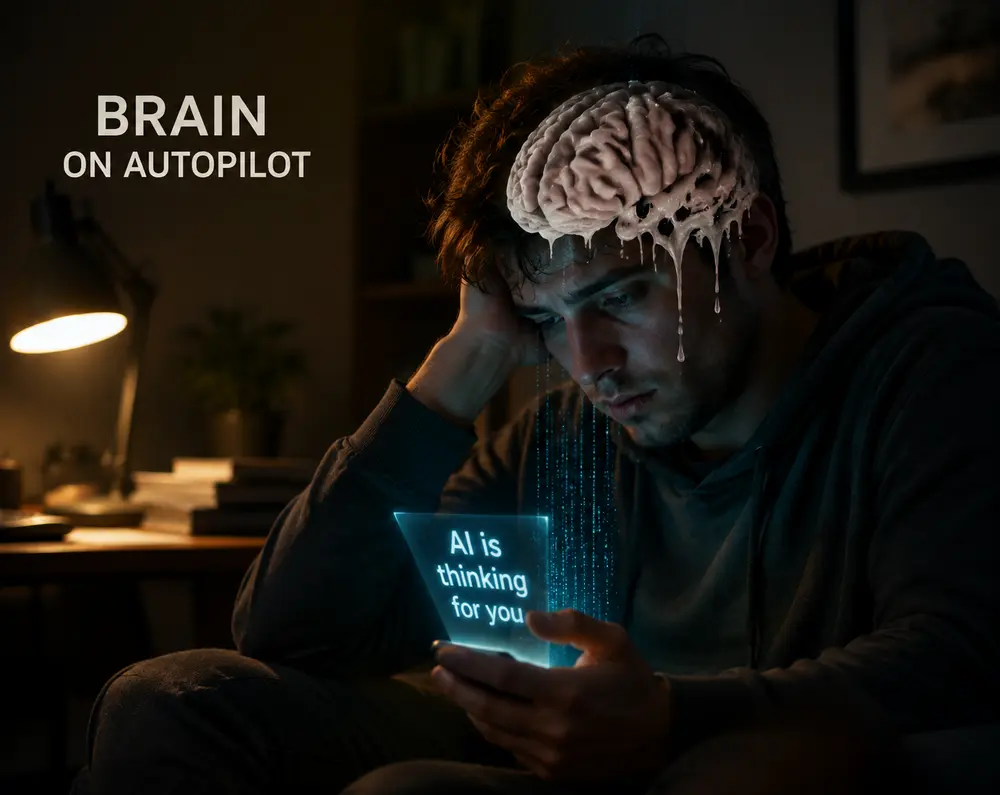
Is AI bad for your brain? What the MIT study found
The most talked-about evidence comes from the MIT Media Lab. In a 2025 study titled "Your Brain on ChatGPT," researchers led by Nataliya Kosmyna asked 54 people to write essays under three conditions: using ChatGPT, using a traditional search engine, or using only their own brains with no tools. Over several sessions across four months, the team recorded brain activity with EEG. The results were striking. The group that relied on the AI showed the weakest neural connectivity, meaning the least communication between brain regions, while the brain-only group showed the strongest, most widespread networks. In other words, writing without help made the brain work harder and engage more fully. The researchers coined a memorable term for the downside of AI convenience: "cognitive debt." Like financial debt, AI spares you effort now but charges interest later, in the form of weaker thinking skills.
Perhaps the most unsettling finding involved ownership and memory. A large majority of the AI group could not accurately quote even a single sentence from the essay they had supposedly just written, because they had not truly composed it. Human graders, unaware of which essays came from which group, described many of the AI-assisted essays as generic and even "soulless." And when the AI users were later asked to write with no tools at all, they still showed weaker brain engagement than people who had never leaned on AI, suggesting the effect lingered. This is the heart of the case that AI may be bad for your brain: it is not just that AI does the work, but that letting it do the work appears to change how your brain shows up for the task.
An honest look at the study's limits
Because intellectual honesty matters, it is important to say what this study did not prove. It was a preprint, meaning it had not yet completed formal peer review. The sample was small, just 54 people, with only 18 completing the final crossover session, and they were mostly students from a handful of universities in one city. It tested only one tool, ChatGPT, on one narrow task, essay writing, in a lab. Crucially, the lead researcher herself pushed back against the most extreme interpretations, stating plainly that the team did not measure IQ and did not find "brain rot," and warning against sensational words like "damage." So the responsible reading is not "AI destroys your brain." It is more modest and still important: when you consistently offload a mental task to AI, your brain engages less, you remember less, and you feel less ownership over the result. That is a genuine cost worth taking seriously, especially if it accumulates over years. Good skepticism cuts both ways: we should neither dismiss the finding nor inflate it into doom.
How AI quietly weakens critical thinking
If the MIT work looked at the brain, a second major study looked at the mind at work. Researchers from Microsoft Research and Carnegie Mellon University, in a 2025 paper presented at the CHI conference, surveyed 319 knowledge workers who use AI tools like ChatGPT and Copilot at least weekly, gathering 936 real-world examples of AI use on the job. Their central finding is one of the clearest warnings yet: the more confidence people had in the AI, the less critical thinking they did. When workers trusted the tool, they tended to accept its output rather than scrutinize it. Conversely, people with higher confidence in their own abilities thought more critically, even though it felt like more effort.
The study also described how AI changes the very nature of thinking at work. Instead of gathering and weighing information themselves, workers shift to verifying what the AI produced. Instead of solving problems, they integrate and tweak AI answers. Instead of doing the task, they supervise the machine doing it. None of that is inherently bad, but it contains a trap the researchers flagged directly: people often skip the critical evaluation precisely when they lack the skill to judge the AI's output. In other words, the people least able to catch an AI's mistakes are the most likely to wave them through. As AI handles more of the routine cognitive load, the human skills needed to oversee it can quietly erode, leaving us confident but less capable, exactly the wrong combination.
The older science: cognitive offloading and the "Google effect"
The worry about AI did not appear from nowhere. It sits on top of decades of research into what psychologists call cognitive offloading: the human habit of pushing mental work onto external aids, from notebooks to calculators to search engines. A landmark 2011 study published in the journal Science by Betsy Sparrow and colleagues showed what has become known as the "Google effect." When people expect to be able to look something up later, they remember the information itself less well, but they remember where to find it. We had already begun outsourcing memory to search engines long before AI arrived. The brain, sensibly, declines to store what it believes it can always retrieve. Generative AI supercharges this dynamic. Search engines still made you read, compare, and synthesize sources. AI hands you a finished answer, removing even those steps. If the Google effect weakened our memory for facts, critics argue, AI threatens to weaken our capacity for the harder work of reasoning, synthesizing, and composing. The concern is not new technophobia; it is an old, well-documented pattern reaching a new extreme.
Automation, deskilling, and "The Glass Cage"
The writer Nicholas Carr has spent more than a decade warning about exactly this. In his book "The Shallows," he argued that the internet was reshaping our attention, training us to skim rather than read deeply. In a later book, "The Glass Cage," he turned to automation and made a point that lands hard in the age of AI: when we automate a skill, we tend to lose it. Pilots who rely too heavily on autopilot can see their manual flying skills decay, with real safety consequences. Doctors who lean on automated diagnostic tools can become less sharp at diagnosis themselves. The pattern is consistent across fields. Automation does not just take over a task; it removes the practice that kept us good at the task. This is the deskilling argument, and it is one of the strongest reasons critics give for limiting AI. If you let AI write for you, you may write worse. If you let it code for you, your own coding may rust. If you let it think through problems for you, your problem-solving muscles get less exercise. The tool that makes you faster today can make you weaker tomorrow.
The erosion of deep thinking and focus
Critical thinking is not a single switch but a set of habits: questioning a claim, weighing evidence, noticing what is missing, holding two ideas in tension, sitting with a hard problem long enough to crack it. Each of these habits is built through repetition, and each can fade through disuse. The danger of always-available AI is that it removes the friction that forces those habits into action. When an answer arrives instantly, polished and confident, the natural human response is to accept it and move on. Why struggle with a blank page when AI will fill it? Why wrestle with a confusing concept when AI will summarize it? The struggle, however, is not a bug to be eliminated; it is often where the learning happens. Cognitive scientists call this "desirable difficulty," the idea that some effort and even some failure make learning stronger and more durable. AI is, in a sense, a machine for removing desirable difficulty. Used carelessly, it can turn active thinkers into passive approvers, people who review and rubber-stamp rather than reason. That shift, repeated thousands of times, is what people mean when they say AI is making our brain mush.
Memory, learning, and the cost of never struggling
Real learning is effortful by design. When you wrestle a difficult idea into your own words, you encode it deeply; you build connections that let you retrieve and use it later. The MIT findings echo this: the brain-only writers not only engaged more during the task, they remembered their work far better afterward. When AI does the encoding for you, there is nothing to retrieve, because you never truly stored it. This matters most for anyone trying to actually learn something rather than just produce an output. A student who lets AI write the essay may hand in good work and learn almost nothing. A professional who lets AI summarize every report may sound informed in the meeting and forget it all by the next. The output looks the same; the human behind it is hollowed out. Over a semester, a career, or a lifetime, the difference between building knowledge and merely renting it from a machine compounds enormously. This is the quiet tragedy critics point to: AI can make you look more capable while making you genuinely less so.
The death of originality: when everything sounds the same
There is also a creative cost. Large language models work by predicting the most likely next words based on enormous amounts of existing text. By design, they gravitate toward the average, the conventional, the already-said. That is why the MIT graders found AI essays generic and "soulless," with repetitive language and standard ideas. When millions of people lean on the same handful of models, a homogenizing pressure follows: emails that sound alike, essays that blur together, designs that converge on the same safe templates. Originality, by contrast, comes from the friction of an individual mind grappling with a problem in its own idiosyncratic way, from the odd connection, the personal voice, the willingness to be a little weird. Outsourcing the first draft to AI does not just save time; it can quietly launder out the very quirks that make work distinctive and human. Critics worry about a future of competent, frictionless, forgettable content, a vast sea of text and images that is technically fine and creatively dead. If you have ever read an obviously AI-written article and felt nothing, you have already met that future.
Deskilling in practice: the abilities we are quietly losing
It is worth being concrete about which skills are at risk. Writing is the obvious one: the ability to structure an argument, find the right word, and revise toward clarity is built only by writing, and it decays when AI writes for you. But the list is longer. Research skills, the patient work of finding, evaluating, and reconciling sources, can wither when AI hands you a synthesized answer with no need to check the originals. Memory and recall suffer when nothing is encoded. Navigation is a vivid example from an earlier wave of technology: many people can no longer find their way without GPS, because they stopped building mental maps. Mental arithmetic faded with calculators. Now reasoning itself, the core human ability to think a problem through, is the skill on the table. None of this means we must reject every tool, of course. But it does mean the choice of what to automate is not neutral. Every time you let AI do something, ask what skill you are choosing not to practice, and whether you are willing to lose it.
What is bad about AI beyond your brain
So far we have focused on the cognitive case. But when people ask "is AI bad," they are often pointing at a wider set of harms that have nothing to do with neural connectivity. These are reasons to be cautious about AI even on days when your brain feels perfectly sharp. They concern accuracy, fairness, truth, privacy, the planet, and human relationships. Taken together, they form the broader argument for stepping back, or at least for treating AI with far more skepticism than the slick marketing invites.
The hallucination problem: confident, fluent, and wrong
AI language models do not "know" facts the way a reference book does. They generate plausible-sounding text, and sometimes that text is simply false, a phenomenon known as hallucination. The danger is that the falsehoods arrive in the same confident, fluent voice as the truths, with no visible warning label. This is not a hypothetical risk. In a widely reported 2023 case, lawyers submitted a legal brief containing court citations that ChatGPT had invented; the cases did not exist, and the lawyers were sanctioned. Students have turned in essays citing studies that were never published. Professionals have shipped reports built on fabricated statistics. The Microsoft and Carnegie Mellon study showed why this is so dangerous: the more we trust the tool, the less we verify, which means hallucinations slip through exactly when our guard is down. An AI that is right ninety-five percent of the time can be more dangerous than one that is right half the time, because it lulls you into trust before the error that matters. If you cannot evaluate the output yourself, you are not using a tool; you are gambling.
Bias baked in
AI systems learn from human data, and human data is full of human bias. As a result, models can reproduce and even amplify stereotypes about race, gender, age, and more. Hiring tools have been found to disadvantage certain groups; image generators have defaulted to narrow and skewed depictions of professions; language models can subtly encode prejudiced assumptions in otherwise neutral-sounding text. The problem is insidious because the bias is laundered through a machine that feels objective. A biased human decision can be questioned; a biased algorithmic decision often hides behind a veneer of mathematical neutrality, making it harder to challenge. When these systems are used to screen job applicants, assess loan risk, or moderate speech, the stakes are real and the harm falls hardest on those already marginalized. Relying uncritically on AI does not remove human bias from decisions; it can entrench it at scale while making it harder to see.
A flood of misinformation and deepfakes
Generative AI has made it trivially easy to produce convincing fake text, images, audio, and video. Deepfakes can put words in a politician's mouth, fabricate a celebrity endorsement, or impersonate a family member's voice in a scam phone call. Even Microsoft has cautioned that no current technology can reliably distinguish AI-generated content from authentic media. The result is a polluted information environment in which seeing is no longer believing, and in which bad actors can flood the zone with plausible falsehoods faster than anyone can debunk them. There is a second, subtler harm: the "liar's dividend." When fakes are everywhere, real evidence can be dismissed as fake too, giving the dishonest a convenient escape from accountability. A healthy society depends on a shared baseline of trustworthy information. By making counterfeit content cheap and abundant, AI strains that baseline, and the cost is borne by everyone who still wants to know what is true.
Your data and your privacy
Every prompt you type into a cloud AI tool is information you are handing to a company. Depending on the service and its settings, your inputs may be stored, analyzed, and used to train future models. People have pasted confidential company documents, private medical details, and personal secrets into chatbots, not always realizing where that data goes or how long it lives. For individuals, this raises real privacy concerns; for businesses, it can mean leaking trade secrets or violating data-protection rules. The convenience of typing anything into a friendly chat window obscures the fact that you are often sending sensitive information to a third party with its own incentives. Critics argue that the rush to adopt AI has outpaced our thinking about consent, ownership, and security, and that we are casually surrendering privacy we will not easily get back.
The environmental cost
AI is not weightless. Training and running large models consumes enormous amounts of electricity and water, the latter used to cool the data centers that house the hardware. As AI is bolted onto more and more products, that demand climbs steeply, and energy analysts have warned that data-center electricity use is rising fast, with AI a major driver. In a world trying to cut emissions, adding a power-hungry layer to everyday tasks, including ones we used to do with a pencil, is a genuine concern. The point is not that every AI query is a sin, but that the invisible cost is real and worth weighing. Asking a giant model to do something a moment of human thought could handle is, among other things, a small environmental extravagance, multiplied by billions of queries a day.
Leaning on AI for comfort and connection
A quieter harm concerns our emotional lives. People increasingly turn to AI chatbots not just for tasks but for company, advice, and reassurance. For some, that can be a helpful supplement. But there is a real risk of over-reliance, of substituting a frictionless, always-agreeable machine for the messy, demanding, irreplaceable work of human relationships. A chatbot will never be tired, never disagree in the way a friend must, never require you to show up for it. That can feel soothing and can subtly erode our tolerance for the give-and-take that real connection requires. There are particular concerns about vulnerable users and young people forming attachments to AI companions in place of human ones. Technology that reduces our need for one another should be approached with caution, not because connection with a tool is always wrong, but because it is no substitute for connection with people, and treating it as one can leave us lonelier than before.
The special danger to students and young brains
If cognitive debt is real, the people most exposed are those whose minds are still forming. The MIT researchers themselves flagged this, suggesting it may be especially important to study AI's effects on teenagers and children, because a brain that is just learning to think may be in greater danger. A student who reaches for AI before doing any thinking of their own may never develop the underlying skills that schooling is supposed to build. The researchers recommended delaying AI use until learners have done enough unaided cognitive work to have something to build on. There is a real difference between a skilled writer who uses AI to speed up a task they could do themselves, and a beginner who uses AI instead of ever learning the task. The first is augmenting an existing ability; the second is skipping its development entirely. For parents and educators, this is perhaps the most urgent reason to set limits: convenience for a child can come at the cost of capability for an adult.
Why "it's just more convenient" is a trap
Every argument for using AI more boils down to convenience: it is faster, easier, less effortful. And that is precisely the trap. The MIT concept of cognitive debt captures it perfectly. Convenience is a loan against your future capability. The interest is invisible at first, a little less memory here, a little less skill there, but it compounds. The most dangerous tools are not the ones that are obviously harmful; they are the ones that feel purely helpful while quietly extracting a cost you do not notice until much later. This is why "but it saves me time" is not a complete answer. The real question is what you do with the time, and what you give up to get it. If AI saves you an hour and you spend that hour thinking harder about a problem only you can solve, you have made a good trade. If it saves you an hour by doing the very thinking that would have made you sharper, you have borrowed against yourself. The goal of stepping back from AI is not to be slower for its own sake. It is to refuse the trades that leave you weaker.
How to stop using AI — or at least take back control
You do not have to delete every AI tool and live in a cabin to protect your mind. For most people, the realistic goal is not total abstinence but deliberate control: deciding when AI serves you and when it is quietly replacing you. Here is how to stop AI from running your thinking, drawing on advice from researchers and from guides like the BBC's on using AI without turning your brain to mush.
First, think before you prompt. Do the initial cognitive work yourself: draft the rough idea, sketch the argument, attempt the problem. Only then bring in AI, to refine rather than to originate. This single habit preserves the "desirable difficulty" that builds skill, and it mirrors the MIT finding that people who thought first engaged their brains far more. Second, use AI as a sparring partner, not an oracle. Ask it to critique your work, poke holes in your reasoning, or offer a counterargument, rather than to hand you the finished product. Third, verify everything that matters. Treat every AI claim as a hypothesis to be checked against a real source, not a fact. Fourth, keep AI-free zones: tasks, days, or domains where you deliberately work unaided to keep your skills sharp, the way an athlete trains without machines. Fifth, notice the feeling of outsourcing. If you cannot explain, in your own words, the thing you just produced, that is a warning sign that you have offloaded the understanding along with the work. Reclaim it.
How to stop AI from hijacking your attention and habits
Controlling AI is partly about habits and friction. The same way people manage social media, you can manage AI. Turn off AI features you do not actually need; many apps now switch them on by default. Add friction to impulsive use, for example by not keeping a chatbot open in a permanent tab so that reaching for it is a choice, not a reflex. Set rules for yourself: no AI for first drafts, no AI for things you are trying to learn, no AI for decisions you should own. If you are a student, follow the researchers' advice and do the unaided work first, using AI only after you have something of your own to compare it to. If you are a professional, protect the parts of your job that are actually your expertise, and let AI touch only the genuine drudgery. The aim is to move from passive, automatic use to active, intentional use, so that you are the one deciding, every time, whether this is a task worth keeping for your own brain.
When you should step back from AI entirely
Some situations call for putting AI down completely, at least for a while. When you are learning something new, do the hard early work yourself; that is when cognitive debt does the most damage and when struggle pays the biggest dividends. When the stakes are high and accuracy is critical, such as legal, medical, or financial matters, do not trust an AI you cannot verify, and bring in qualified humans. When the task is the point, for instance when the goal is to develop your own writing voice, your own analytical ability, or your own creativity, AI shortcuts defeat the purpose. When privacy matters, keep sensitive information out of cloud tools. And when you simply want to think, to reflect, to be bored productively, resist the urge to fill every gap with a prompt. Some of our best ideas come from the unhurried, undirected wandering of a mind left alone. An AI in every silence is an AI that never lets you hear yourself think. Knowing when to abandon the tool is as much a skill as knowing how to use it, and it is one worth cultivating deliberately.
The case against throwing it all away
Honesty requires acknowledging the other side, because the strongest version of this argument is not anti-technology hysteria. AI is genuinely useful, and pretending otherwise would be its own kind of mush. The same MIT study that warned about cognitive debt also found that experienced people who had already done the thinking could use AI to good effect, engaging deeply and recalling well, because they brought their own judgment to it. The Microsoft and Carnegie Mellon researchers did not call for abandoning AI; they called for designing and using it in ways that preserve human critical thinking. AI can remove genuine drudgery, expand access to information for people who lacked it, help non-native speakers communicate, support people with disabilities, and accelerate real discovery in science and medicine. The problem was never the existence of a powerful tool. The problem is unthinking, total, default reliance, the kind that replaces the human instead of extending them. The realistic and honest conclusion is not "never use AI." It is "use AI on purpose, for the right things, in a way that keeps you sharp." Which brings us to the verdict.
AI, work, and the skills that will still matter
Look past the hype cycle and a clear picture emerges of which human abilities will hold their value. As AI absorbs routine cognitive labor, the premium shifts to the things AI cannot reliably do: genuine critical judgment, original thinking, taste, ethical reasoning, the ability to ask the right question rather than just answer a given one, and the wisdom to know when the machine is wrong. Ironically, those are exactly the skills that atrophy under heavy, unthinking AI use. So there is a paradox at the heart of the AI workplace: the more everyone leans on AI, the more valuable the people who have kept their own minds sharp become. The worker who can think independently, verify rigorously, and add something the model cannot is not made obsolete by AI; they are made rare. This is a practical, even self-interested reason to protect your cognition. Cultivating the discipline to think for yourself is not nostalgia. In an AI-saturated economy, it may be the most durable career advantage you can build.
Building a healthier relationship with AI
A healthy relationship with any powerful tool is built on intention and limits, not on abstinence or surrender. With food, we learn to enjoy without bingeing. With alcohol, moderation. With social media, boundaries. AI deserves the same maturity. That means being honest with yourself about when you are using AI to extend your abilities versus to avoid using them. It means treating the convenience as something to spend wisely rather than to maximize. It means keeping a clear line between the tasks you are happy to automate and the capacities you refuse to lose. And it means periodically checking in: am I still able to do this without the tool? If the answer is drifting toward no, that is the moment to step back and rebuild the skill. The goal is to remain the author of your own thinking, with AI as an instrument you pick up and put down by choice, never a crutch you cannot walk without. People who manage that balance get the benefits of AI without paying the full cognitive debt. People who do not are the ones whose brain, eventually, feels like mush.
A simple rule: automate the chore, keep the thinking
If you take one principle from this article, make it this: automate the chore, but keep the thinking. The harm in AI comes overwhelmingly from outsourcing the cognitive work that makes you capable, your reasoning, your writing, your learning, your judgment. The benefit comes from offloading the mechanical, repetitive, low-value tasks that consume your time without building your mind. The art of using AI well is drawing that line clearly and holding it. Do not let AI think for you. Do let it handle the busywork that was never going to make you smarter in the first place: reformatting, reorganizing, tedious assembly, mechanical production. The hours you reclaim from genuine drudgery are hours you can pour back into the deep, effortful work that only a human mind can do. That is not cognitive debt; that is a smart trade. And there is one classic chore that fits this rule almost perfectly.
The illusion of understanding
One of the subtlest dangers of AI is that it manufactures a feeling of competence that outruns the real thing. When a model produces a fluent explanation, a polished essay, or working code, it is easy to mistake possessing the output for understanding it. Psychologists call this the illusion of explanatory depth: we routinely believe we understand things far better than we do, and AI inflates that illusion to new heights. You can ship a report you could not defend, pass off an analysis you could not reconstruct, and answer a question you could not actually solve. The gap between looking capable and being capable widens with every task you hand off. This matters because the moment of truth always comes eventually: the meeting where you are asked to go deeper, the exam with no devices, the real problem the AI gets wrong. People who have built genuine understanding can handle that moment; people who have only rented it from a machine are exposed. The fluency of AI is seductive precisely because it feels like knowledge. Treating that feeling with suspicion is one of the most protective habits you can develop.
Patience, boredom, and the lost art of sitting with a problem
Hard thinking requires tolerating discomfort: the frustration of a problem that will not yield, the boredom of a blank page, the slow churn before insight arrives. These uncomfortable states are not obstacles to thinking; they are the conditions for it. Some of the most important ideas in history came to people who were stuck, bored, or daydreaming, their minds quietly working in the background. AI offers an instant escape hatch from all of that discomfort. Stuck? Prompt. Bored? Prompt. Unsure? Prompt. Each escape feels harmless, but together they train us out of the very patience that deep work demands. We lose the capacity to sit with a question long enough for our own answer to surface. A mind that never tolerates not-knowing never gets to experience the particular satisfaction of working something out for itself. Protecting a little boredom, a little productive struggle, a little silence without a prompt, may be one of the quietly radical acts of the AI age.
What earlier technologies can teach us
None of this is the first time a tool has reshaped human cognition, and history offers a balanced lesson. Writing itself was once feared, famously by Socrates, who worried it would weaken memory. He was partly right; oral cultures had prodigious memories that literate ones lost. But writing also enabled science, law, and literature, a trade most would make again. Calculators did erode mental arithmetic, yet freed mathematicians for higher work. GPS did weaken our innate sense of direction, yet got us places we could never have navigated alone. The pattern is consistent: each tool gives a capability and quietly takes one. The lesson is not that progress is bad, but that the trade is real and worth choosing consciously rather than sleepwalking into. What makes AI different is its breadth. Earlier tools offloaded a specific, narrow skill. General-purpose AI can offload thinking itself, across nearly every domain at once. That is what raises the stakes, and why the old advice, use the tool but keep the skill, has never mattered more.
Signs you may be over-relying on AI
How do you know if you have crossed from healthy use into dependence? A few honest signals are worth watching for. You reach for AI reflexively, before even attempting the task yourself. You cannot explain, in your own words, work you just produced with AI. You feel anxious or stuck when the tool is unavailable. You accept AI outputs without checking them, even on things that matter. You notice your own writing, reasoning, or recall feeling rustier than it used to. You struggle to focus on a problem long enough to make progress without prompting. You realize you have learned very little despite producing a lot. If several of these ring true, it is not cause for panic, but it is a clear invitation to recalibrate: to reintroduce friction, do more unaided work, and rebuild the muscles that have gone quiet. Awareness is the first step. You cannot manage a dependence you refuse to notice, and the tools are designed to make non-use feel needlessly hard.
A practical reset: rebuilding your thinking in one week
If this article has convinced you that you have drifted into over-reliance, you do not need a dramatic detox. A short, structured reset can rebuild the habits that matter. Try a one-week experiment. On day one, simply observe: note every time you reach for AI and ask whether you could have done it yourself. On day two, reintroduce friction by closing your AI tabs and turning off default AI features, so each use becomes a deliberate choice. On day three, practice thinking first: for every task, sketch your own answer before consulting any model. On day four, use AI only as a critic, asking it to challenge your work rather than produce it. On day five, pick one skill you care about, writing, coding, analysis, and do it entirely unaided, accepting that it will feel slower and harder. On day six, verify aggressively: fact-check every AI claim you encounter against an original source. On day seven, reflect on what changed: did your focus improve, did the work feel more like your own, did you remember more? Most people find that a single week of intentional use restores a surprising amount of mental sharpness and, just as important, a sense of agency. The point is not to prove you can live without AI, but to prove that you, not the tool, are in charge of when it is used. From that position of control, AI becomes what it should always have been: a powerful instrument you command, rather than a habit that commands you.
Conclusion: a double-edged sword, used with wisdom
So, should you stop using AI? The honest answer is that AI is a double-edged sword, and the right choice depends entirely on the situation. Used as a substitute for your own thinking, especially while you are learning, AI can quietly run up a cognitive debt: weaker memory, shallower critical thinking, faded creativity, as the research from MIT, Microsoft, and Carnegie Mellon suggests. Add the wider harms, hallucinations, bias, misinformation, privacy and environmental costs, and the case for restraint is serious. But used deliberately, for the right tasks, by someone who keeps their own judgment switched on, AI can free you from drudgery and let you spend your finite mental energy where it truly counts. The verdict is not "abandon AI" or "embrace AI," but "choose, every time, on purpose." Think of AI the way a skilled craftsperson thinks of a power tool: indispensable for the heavy, repetitive cuts, but never a replacement for the eye, the hand, and the judgment that make the work yours. The people who will thrive in the coming years are not those who use AI the most, nor those who refuse it entirely, but those who are deliberate, who know their own minds well enough to guard what matters and delegate what does not. Protect the thinking. Offload the chores.
Building presentation slides is the perfect example of a chore worth offloading. Formatting decks, aligning boxes, choosing layouts, and wrestling with design is the kind of tedious, mechanical work that drains hours without making you any wiser. This is exactly where AI earns its keep. When it comes to that notorious time-sink of PowerPoint making, use Smallppt. Smallppt is an AI presentation maker that turns a topic or text into a polished, professional deck in minutes, handling structure, layout, and design for you. It dramatically reduces the time you spend on slide-making so you can use your time as efficiently as possible, pouring the hours you save back into the parts of your work that actually require your mind: the ideas, the argument, the judgment, the human spark no model can replace. That is the double-edged sword used wisely, letting AI take the chore so you can keep the thinking.
Is AI bad for your brain?
It can be, if you over-rely on it. A 2025 MIT Media Lab study found that people who used AI to write engaged their brains less and remembered their work poorly, an effect the researchers called "cognitive debt." However, the study was small and preliminary, and its lead author cautioned against claims of "brain damage." The honest takeaway: outsourcing your thinking to AI has real cognitive costs, so use it deliberately.
How do I stop using AI so much?
Aim for control, not total abstinence. Think and draft before you prompt, use AI to critique rather than create, verify everything important, turn off AI features you do not need, and keep AI-free zones for tasks you want to stay sharp at. The goal is intentional use instead of automatic reliance.
Does AI really weaken critical thinking?
Research suggests it can. A 2025 Microsoft and Carnegie Mellon study of 319 knowledge workers found that the more people trusted AI, the less critical thinking they did, often accepting outputs without scrutiny, especially when they lacked the skill to judge them.
What is bad about AI besides its effect on the brain?
Key concerns include hallucinations (confident but false outputs), built-in bias, a flood of misinformation and deepfakes, privacy risks from the data you feed it, and significant energy and water use. These are reasons to use AI cautiously and verify its output.
Should I stop using AI completely?
Not necessarily. AI is a double-edged sword. It is wise to step back when you are learning, when accuracy is critical, when the task is meant to build your own skill, or when privacy matters. But for genuine drudgery, like formatting slides, AI can save real time. The skill is choosing when to use it and when to put it down.
If AI is risky, why use a tool like Smallppt?
Because the smart rule is "automate the chore, keep the thinking." Slide formatting is mechanical busywork that does not build your mind, so letting an AI tool like Smallppt handle it frees your time and energy for the thinking that does. That is using AI for the right thing.