
Most of us assume we are too sharp to fall for a phone scam. That confidence is exactly what modern fraudsters are counting on. With three or four seconds of recorded audio, an attacker can now clone a voice well enough to fool a family member, a bank, or a healthcare call center. This is where the agentic AI Pindrop Anonybit approach comes in — a layered model that pairs real-time voice analysis, privacy-preserving biometrics, and autonomous decision-making to catch synthetic voices before they cause damage.
This guide explains what Pindrop is, what it can do, how its deepfake detection approach works, what it costs, where it falls short, and how it honestly stacks up against general-purpose AI like ChatGPT and Gemini. It closes with broader anti-fraud solutions you can deploy alongside it.
Fraud Is Running Rampant — and AI Made It Worse
The scale of the problem is no longer theoretical. According to the U.S. Federal Trade Commission, consumers reported losing $12.5 billion to fraud in 2024, drawn from roughly 2.6 million reports — a sharp jump driven in part by AI-enabled impersonation (FTC, March 2025).
The voice channel is a favorite target:
- Pindrop's 2025 Voice Intelligence & Security Report documented a 1,300%+ surge in deepfake fraud, plus a rise in "deepfake job candidates" using cloned voices and video to deceive recruiters.
- Contact-center fraud rose roughly 60% over two years, and by recent estimates 1 in every 730 calls to a contact center is fraudulent — an estimated $5 billion annual risk to U.S. contact centers.
- One widely cited early case: in 2019 a UK energy firm's CEO was tricked into wiring roughly $243,000 after a deepfaked voice mimicked his parent-company boss.
Traditional defenses — passwords, security questions, IP blocklists — are static and rules-based. Attackers only need one successful probe to learn the rules and walk right through them. Generative AI lets them probe thousands of times and then synthesize a convincing voice in seconds. The defenses have to become dynamic, contextual, and autonomous. That is the core argument for agentic AI in identity security.
What Is Pindrop, and What Can It Do?
Pindrop is a voice-security and identity company founded in 2011 in Atlanta by Dr. Vijay Balasubramaniyan, Dr. Paul Judge, and Dr. Mustaque Ahamad, and backed by investors including Andreessen Horowitz, Citi Ventures, CapitalG, GV, IVP, and Vitruvian Partners. It specializes in voice authentication, fraud detection, and deepfake detection for contact centers and, more recently, live meetings.
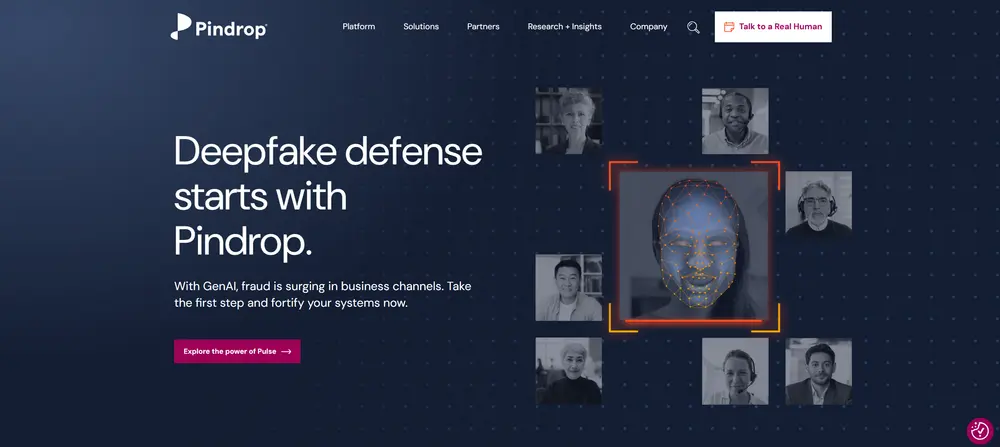
Rather than simply matching a caller's voice to a stored voiceprint, Pindrop analyzes more than 1,300 voice, device, and behavioral signals to produce a single risk score and a "liveness" score — a real-time signal indicating whether a voice belongs to a live human or a synthetic source. As of its public disclosures, the company reported analyzing 5.3 billion calls, preventing roughly $2 billion in fraud losses, and detecting 104 million spoof calls.
The core product family:
| Product | What it does |
|---|---|
| Pindrop® Protect | Multi-layered fraud detection that delivers one risk score across both the IVR and live-agent stages of a call. |
| Pindrop® Passport | Passive multifactor authentication that verifies genuine callers without security questions or one-time passcodes. |
| Pindrop® Pulse | AI-powered deepfake/liveness detection that flags synthetic audio in about two seconds. |
| Pindrop® Pulse for Meetings | Real-time deepfake detection, attendee authentication, and geolocation checks for video meetings. |
| Pulse Inspect / fraud-investigation agent | Tools that re-score prior calls with new intelligence and an AI agent that helps investigators resolve phone-fraud cases faster. |
Pindrop's credibility markers are worth noting for trust signals: it was the sole large-organization winner of the 2024 U.S. Federal Trade Commission Voice Cloning Challenge, and in 2026 TIME named it to its list of the most influential software companies alongside Microsoft, Adobe, and Figma. In healthcare, customer HealthEquity reported a 90%+ reduction in voice fraud after deployment.
The Pindrop Deepfake Detection Approach Explained
Pindrop's deepfake detection approach is built on the idea that synthetic speech leaves artifacts humans can't hear but machines can measure. The Pulse engine listens for tells such as:
- Odd compression signatures left by text-to-speech pipelines
- Unnatural frequency distributions a real vocal tract wouldn't produce
- Missing background and room cues that genuine live audio almost always carries
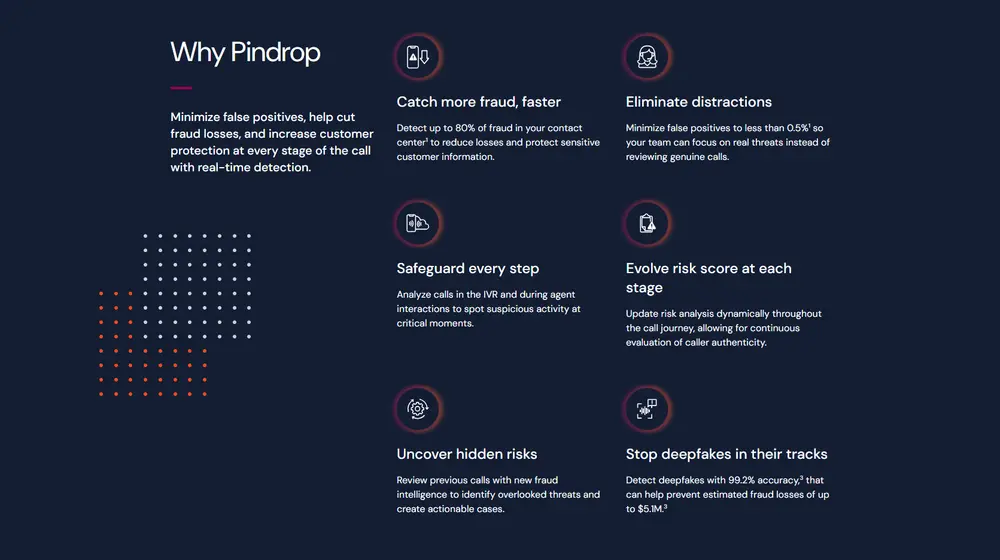
From these and other signals it issues a liveness score in roughly two seconds. The company reports up to 99.2% accuracy on synthetic and bot-generated speech, and — when Pulse is combined with its multifactor authentication platform — up to 99.4% accuracy with under 1% false positives. Crucially, it claims the ability to spot previously unseen deepfakes at 90%+ accuracy, which matters because attackers constantly switch voice-synthesis tools. Pindrop holds 75+ deepfake-related patents backing this work.
The key design principle: detect the fake before a human agent is ever exposed to the manipulation, ideally during the opening IVR menu, then route high-risk calls to specialized fraud teams instead of general agents.
Building Trust With Agentic AI From Pindrop — and Anonybit
A liveness score alone is just a signal. The "building trust with agentic AI from Pindrop" idea is about what happens after the signal fires — and this is where the agentic AI Pindrop Anonybit framework comes together as three complementary layers:
| Layer | What it handles | Purpose |
|---|---|---|
| Pindrop | Verifies whether a caller's voice is the real account owner or a deepfake | Audio verification |
| Anonybit | Confirms biometric identity without exposing the raw biometric data | Identity management |
| Agentic AI | Reads context across signals and decides the next action | Autonomous decision-making |
Anonybit contributes decentralized biometric authentication. Instead of storing fingerprints, face, or voice data in one central vault, it cryptographically fragments that data across multiple clouds and data centers — a zero-knowledge-style design that lets the system verify identity without ever reassembling a complete biometric record. This reduces the blast radius of any single breach and aligns with data-minimization rules like GDPR and HIPAA.
Agentic AI is the decision-maker. Where a legacy system simply matches a password, an agentic layer notices that thousands of login attempts in seconds is suspicious behavior and blocks it — and after a risk signal from Pindrop or Anonybit, it can allow the interaction, demand step-up verification, route the case, or escalate to a human team. That contextual, autonomous reasoning is what "building trust with agentic AI from Pindrop" really means: trust becomes a continuous, evidence-weighted decision rather than a one-time gate.
Pindrop Company MSSP Solutions and Deployment
Pindrop is an enterprise platform, not a consumer app, and most large organizations don't run voice security in isolation. This is where Pindrop company MSSP solutions fit: managed security service providers (MSSPs) and integration partners increasingly bundle voice-fraud detection into the broader security operations they run for banks, insurers, healthcare networks, and retailers. For a company that outsources its security stack, Pindrop's Protect/Passport/Pulse suite slots in as the voice-channel layer alongside SIEM, identity, and bot-management tooling an MSSP already manages — and a partner can handle tuning, monitoring, and case escalation. If you don't have an in-house fraud team, an MSSP-led deployment is often the most realistic path to value.
Pindrop Features, Strengths, and Shortcomings
Strengths
- Speed and accuracy: ~2-second deepfake verdicts with high reported accuracy and low false positives.
- Passive, low-friction: authenticates genuine customers without interrogating them with security questions.
- Breadth of signals: 1,300+ voice, device, and behavioral factors rather than a single voiceprint.
- Generalization: designed to catch unseen deepfakes, not just known samples.
- Real-world validation: FTC challenge win, large enterprise deployments, billions of calls analyzed.
Shortcomings
- Not flawless: verified users on Gartner Peer Insights note it can occasionally let calls "slip through" — no detection system is impenetrable, and a misconfigured deployment weakens it.
- Enterprise-only and opaque pricing: there is no public price and no self-serve tier; this is not for small businesses or individuals.
- Integration effort: value depends on tuning to your contact-center environment and call volume.
- Voice-channel focus: it is one layer; you still need protections for digital, email, and identity-proofing flows (which is exactly why pairing it with biometrics like Anonybit is recommended).
How Much Does Pindrop Cost?
Pindrop does not publish pricing. Both Gartner Peer Insights and software directories confirm that pricing is custom and quote-based, structured as annual or multi-year subscriptions that scale with call volume and implementation requirements, with possible add-on costs for integration support and premium features. Expect an enterprise procurement process and a tailored quote rather than a price tag. For budgeting, treat it as a six-figure-plus annual contract typical of contact-center security platforms, and request a quote scoped to your call volume.
What Real Users Say
Independent review sentiment is modest in volume but generally positive. On Gartner Peer Insights, Pindrop's fraud products carry ratings in the 4.4–4.6 star range from verified reviewers. Paraphrasing that real-user feedback:
- One daily user said the product does a solid job intercepting fraud and praised recent interface updates, while candidly noting it has occasionally let a call slip through.
- Another described it as user-friendly and noted it loads quickly.
- On the buyer side, reviewers point to strong visibility into caller behavior and reasonably smooth integration with existing security layers, with some upfront fine-tuning required.
The recurring theme: effective and low-friction in practice, but it rewards careful configuration and isn't a set-and-forget magic box.
💡A note for readers arriving via a search spike:: a surge in search volume around a security vendor doesn't indicate a breach or any problem with the product — it usually tracks news coverage, awards, or viral deepfake stories. Always evaluate a security tool on documented capabilities and verified reviews, not on traffic trends.
Beyond Pindrop: Other Solutions for Rising Fraud
A layered "defense in depth" beats any single product. Alongside (or instead of) Pindrop, consider:
- Decentralized biometrics (e.g., Anonybit): verify identity without a central honeypot of biometric data, reducing breach impact and supporting GDPR/HIPAA.
- Adaptive / risk-based MFA: move beyond static OTPs to context-aware step-up authentication that reacts to anomalous behavior.
- Multimodal deepfake detection: add face-swap and video-injection detection — face-swap attacks rose sharply per iProov data cited in industry reports — for video meetings and onboarding.
- MSSP-managed monitoring: outsource 24/7 detection, tuning, and response to a managed security service provider if you lack an in-house team.
- Verification rituals for families and staff: simple, low-tech "code word" protocols defeat the "loved-one in distress" voice-clone scam.
- Employee and customer training: the FTC and CISA both publish free guidance on spotting AI impersonation — human awareness remains a frontline control.
Authoritative resources worth bookmarking: the FTC fraud data and consumer alerts, the CISA guidance on deepfakes and synthetic media, and the NIST AI Risk Management Framework for organizations building governance around AI-driven threats.
Conclusion
Fraud is a cat-and-mouse game, and generative AI has handed the mouse a rocket. Static passwords and stored voiceprints can't keep up with voices that can be cloned in seconds. The agentic AI Pindrop Anonybit framework answers that by combining Pindrop's real-time deepfake detection approach, Anonybit's privacy-preserving biometrics, and an agentic decision layer that reasons about context and acts. It isn't an impenetrable wall — no system is, and deployment expertise matters — but as a model for building trust with agentic AI from Pindrop, it's one of the strongest blueprints available today. Pair it with adaptive MFA, multimodal detection, MSSP-managed monitoring, and good old human awareness, and you have a defense built for the AI era.
FAQs
What is the difference between Pindrop and traditional voice authentication?
Traditional voice authentication matches a caller's voice to a stored voiceprint. Pindrop analyzes 1,300+ voice, device, and behavioral signals to detect fraud and deepfakes in real time, producing a risk and liveness score rather than a simple match.
Is the agentic AI Pindrop Anonybit framework GDPR and HIPAA compliant?
Anonybit's decentralized, privacy-by-design architecture is built to support compliance with regulations like GDPR and HIPAA by fragmenting biometric data rather than storing it centrally. Always confirm specifics with each vendor for your jurisdiction.
Does it work for video calls?
Yes. Pindrop Pulse for Meetings extends real-time deepfake detection and attendee authentication to live video meetings, and the framework can be layered onto video onboarding flows.
How much does Pindrop cost?
Pricing is custom and quote-based, sold as annual or multi-year subscriptions scaled to call volume and implementation needs. There is no public price or self-serve tier.
Is Pindrop only for big companies?
In practice, yes — it's an enterprise contact-center platform. Smaller organizations typically access similar protection through an MSSP that manages it on their behalf.