
Some people seem born to present, but the truth is that great presenters are made, not born. The confidence, clarity and stage presence you admire are simply presentation techniques that anyone can learn, practice and master.
Whether you are pitching to investors, teaching a class, or speaking at a conference, the right techniques turn a nervous, forgettable talk into one that holds attention and drives action.
In this guide you will find 20 effective presentation techniques explained in detail, practical ways to practice your speaking ability in everyday life, and how to make great presentation slides quickly before you step on stage. Think of it as a complete, do-it-yourself presentation techniques training program you can start using today.
- Presentation techniques can be learned and improved through training and daily practice, not just natural talent.
- A great presentation combines solid preparation, clean visuals and confident delivery.
- Build your speaking ability with small daily habits like reading aloud, recording yourself and impromptu talks.
- Engage your audience with stories, eye contact, vocal variety and a memorable close.
- Strong slides support your message, and tools like smallppt cut slide-making time from hours to minutes.
What are presentation techniques, and why does training matter?
Presentation techniques are the specific, repeatable skills that help you communicate an idea clearly and persuasively to an audience. They cover everything from how you structure your content and design your slides to how you use your voice, body and eye contact while speaking. The reason presentation techniques training matters is simple: these are skills, not fixed traits. Just like learning an instrument, the more you study effective presentation techniques and practice them deliberately, the better and more natural you become. Below are 20 techniques worth mastering, grouped so you can work on them one area at a time.
20 effective presentation techniques
Preparation and structure
1. Know your audience
Before you write a single slide, learn who you are speaking to, what they already know, and what they care about. Tailor your message, examples and level of detail to them, because a talk that lands with executives will fall flat with students, and vice versa.
2. Define one core message
Decide the single idea you want everyone to remember, and make sure every slide and story serves it. If your audience could only take away one sentence, what should it be? Build the whole presentation around that answer.
3. Structure with a clear arc
Give your talk a strong beginning, a logical middle and a memorable end. A simple, story-like structure, set up the problem, explore it, then resolve it, is far easier to follow than a loose collection of facts.
4. Open with a hook
You have about 30 seconds to earn attention, so do not waste them on logistics. Start with a surprising statistic, a provocative question, or a short, relevant story that makes the audience want to hear more.
5. Plan your timing
Rehearse to fit the slot you are given, aiming for roughly one slide per minute. If you have far more slides than minutes, you are trying to say too much, so cut until only the essential points remain.

Slides and visuals
6. Keep one idea per slide
Crowded slides overload your audience, who end up reading instead of listening. Limit each slide to a single point and follow the 6x6 rule: no more than about six words per line and six lines per slide.
7. Let visuals do the work
Wherever possible, replace blocks of text with images, charts and diagrams, and tell the audience exactly what they are looking at. A clear graph communicates a trend faster than a paragraph ever could.
8. Design for readability
Use a clean sans-serif font at 24 point or larger, keep high contrast between text and background, and leave generous white space. Stay consistent with fonts and colors throughout so the design never distracts from your message.
9. Reveal content progressively
Instead of showing a full slide at once, bring points in as you discuss them. This keeps the audience focused on what you are saying now rather than reading ahead.
Delivery and body language
10. Make eye contact
Connect with individuals across the room rather than staring at your slides or the back wall. Holding someone's gaze for a few seconds at a time makes your delivery feel personal and confident.
11. Use open body language
Face your audience with a relaxed, upright posture and let your hands gesture naturally. Open posture signals confidence and approachability, and it noticeably increases how engaged your audience feels.
12. Move with intention
Use the space available to you instead of hiding behind a lectern, but avoid aimless pacing. Purposeful movement, stepping forward to make a key point, for example, adds energy and emphasis.
13. Never read your slides
The text on screen is for the audience; your job is to tell the story around it. Use your slides as cues, keep your notes brief, and speak to people rather than to the screen.
14. Manage your nerves
Slow, deep breaths and a measured pace calm your body and your voice. Remember that nervous energy is just adrenaline, channel it into enthusiasm, and lean on thorough preparation to shrink the fear.

Voice and language
15. Vary your vocal delivery
A monotone voice loses an audience fast. Change your pitch, pace and volume to add light and shade, speeding up for excitement and slowing down to underline something important.
16. Use pauses deliberately
Silence is one of the most underused presentation techniques. A well-placed pause emphasizes a key point, gives the audience time to absorb it, and makes you look calm and in control.
17. Keep language simple and concrete
Favor short sentences, plain words and vivid examples over jargon and abstraction. The easier you are to understand, the more persuasive and memorable you become.
Engagement and closing
18. Involve your audience
Ask questions, run a quick poll, or invite a show of hands to turn passive listeners into active participants. Varying your media, a short video clip or a live demo, also resets attention.
19. Tell stories and use examples
People remember narratives far better than data alone. Wrap your key points in real stories, case studies or analogies so they stick long after the talk ends.
20. End with a strong call to action
Because attention peaks at the end, your final moments matter most. Restate your core message and tell the audience exactly what you want them to think, feel or do next.
Presentation techniques training: how to practice your speaking ability every day
Reading about effective presentation techniques is a start, but real improvement comes from practice, and you do not need a stage to get it.
The best presentation techniques training happens in small, daily doses woven into ordinary life. Treat everyday conversations, errands and downtime as low-stakes rehearsal, and your confidence will grow steadily without you ever having to schedule a big practice session. The table below shows simple habits you can build into your routine.
| Daily habit | How it builds your speaking ability |
|---|---|
| Read aloud for a few minutes | Improves pronunciation, pacing and breath control, and gets you comfortable hearing your own voice. |
| Record and review yourself | Reveals filler words, rushed sections and nervous habits so you know exactly what to work on. |
| Do one-minute impromptu talks | Pick a random object or topic and speak for 60 seconds to train you to think and talk on your feet. |
| Narrate everyday tasks | Explaining what you are doing out loud sharpens your ability to structure thoughts clearly and quickly. |
| Join a speaking group | A club such as Toastmasters offers regular, friendly practice and honest feedback in a supportive setting. |
| Study great speakers | Watch talks you admire and copy their techniques for pausing, storytelling, emphasis and movement. |
| Practice in front of others | A friend, family member or even a mirror builds your comfort with an audience and gives you feedback. |
| Expand your vocabulary | A richer word bank lets you express ideas more precisely and react with confidence when put on the spot. |
How to make great presentation slides before you deliver
Even the best speaker needs slides that support the story. Before you present, build your deck the smart way: start from your outline, give every slide one clear idea and an informative title, use visuals instead of walls of text, and keep fonts and colors consistent from start to finish. Review the whole deck as a first-time viewer would, fix anything cluttered or hard to read, and rehearse with the slides until your timing feels natural.
The catch is that designing polished slides from scratch can eat hours you would rather spend rehearsing. This is where smallppt becomes one of the easiest ways to cut your presentation-making time. Describe your topic in a few words, or import your notes, and its AI generates a complete, well-structured deck in about a minute. You can then switch templates in one click, adjust colors, fonts and layout, and export to PowerPoint or Google Slides, turning hours of formatting into minutes of light editing so you can focus on your delivery instead.
And if you are short on design inspiration, you do not have to start from a blank slide. smallppt offers 1000+ free templates across business, education, marketing and more, so you can pick a polished, professional look and make it your own in minutes.
Open Smallppt's template library and search for "Christmas" to browse the matching festive designs.
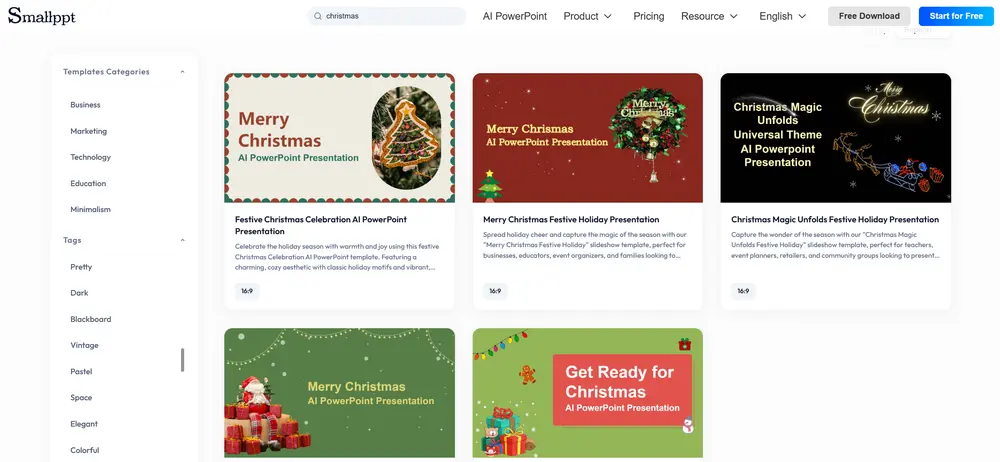
Click "Generate with AI" on the festive template, or simply download it and manage the deck yourself.
Two ways to start
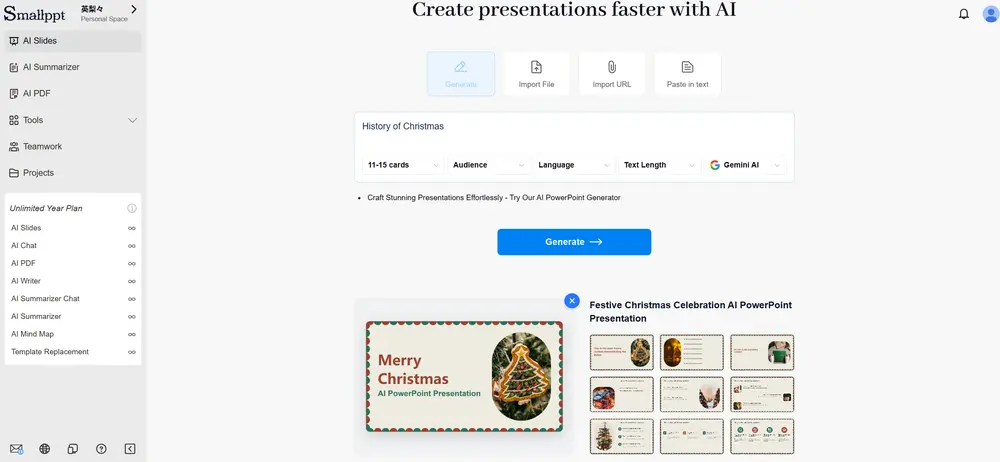
Type a few keywords about your holiday topic, set options like card count and language, then click Generate.
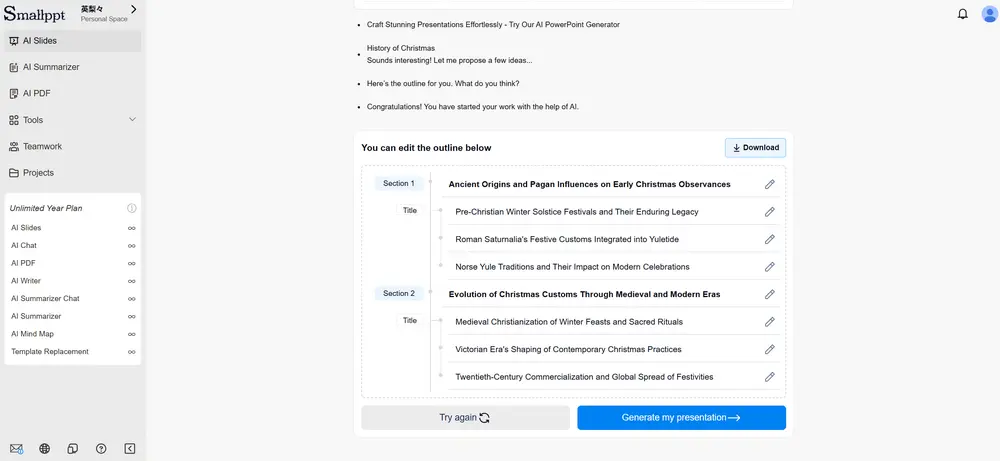
Review and edit the AI-generated outline, then click "Generate my presentation" to build the full deck.
Fine-tune every slide yourself until the festive look is exactly what you want.
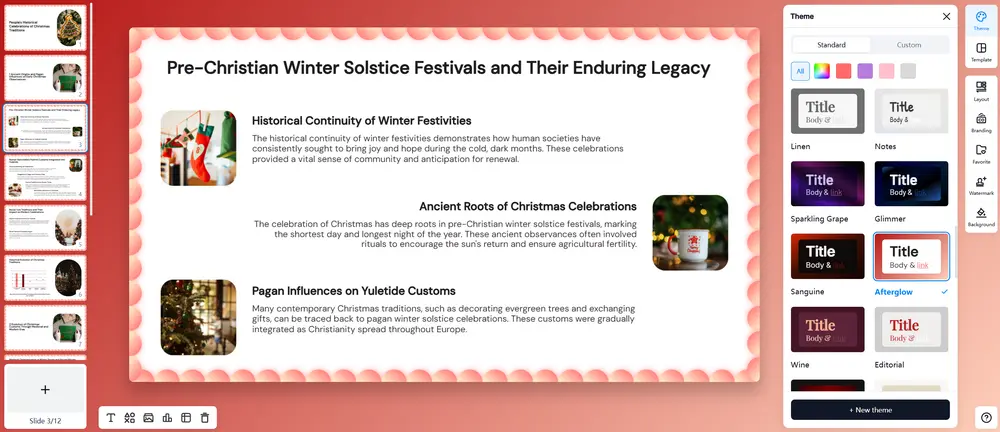
Smallppt delivers a complete, beautiful slide deck in roughly 20 seconds. From there you can easily edit the theme colors, layout and fonts, insert charts and tables, and manage your watermark. Every feature you need is built into Smallppt.
Rate My Presentation: check your deck before you present
Not sure whether your slides actually land? Before you present, it helps to get an objective second opinion, and Smallppt's latest Rate My Presentation feature gives you exactly that.
It evaluates your deck across five dimensions and more than 100 criteria, then returns clear, specific feedback along with concrete revision points, so you know precisely what is working and what to fix.
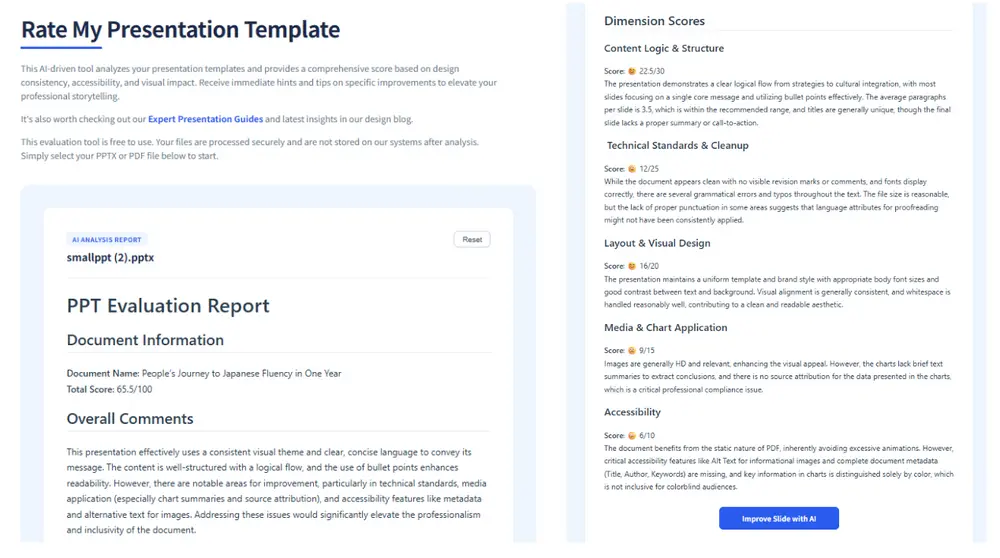
Instead of guessing, you get a structured read on your presentation and a short list of improvements that will make the biggest difference. Once you have seen your results, you can act on them right away: click the button below to let Smallppt help you improve the slides effortlessly.
Conclusion
Becoming a confident, compelling speaker is not about a secret gift, it is about applying proven presentation techniques and practicing them until they feel like second nature. Master the fundamentals of preparation, slide design, delivery, voice and audience engagement, then sharpen your speaking ability a little every day through simple habits. When it is time to build your deck, save your energy for rehearsal by letting smallppt handle the design. Put these effective presentation techniques into practice, and your next presentation will be one your audience actually remembers.
What are presentation techniques?
Presentation techniques are the repeatable skills that help you communicate clearly and persuasively, covering how you structure content, design slides, use your voice and body, engage the audience and handle nerves. They can all be learned and improved with practice.
What are the most effective presentation techniques?
Some of the most effective presentation techniques are knowing your audience, defining one core message, opening with a hook, keeping one idea per slide, using strong visuals, making eye contact, varying your voice, using deliberate pauses, telling stories, and ending with a clear call to action.
Is presentation techniques training worth it?
Yes. Presentation skills are learned, not innate, so training and regular practice deliver real, lasting improvement. You can train formally through a course or speaking group, or informally with daily habits like reading aloud, recording yourself and giving short impromptu talks.
How can I practice my speaking ability in daily life?
Weave small habits into your routine: read aloud, record and review yourself, give one-minute impromptu talks, narrate everyday tasks, study speakers you admire, and practice in front of a friend or mirror. A speaking group such as Toastmasters adds regular feedback.
How do I make great presentation slides quickly?
Start from an outline, give each slide one clear idea and an informative title, use visuals over text, and keep the design consistent. To save time, let smallppt generate a complete, editable deck from a few keywords in about a minute, or start from one of its 1000+ free templates.